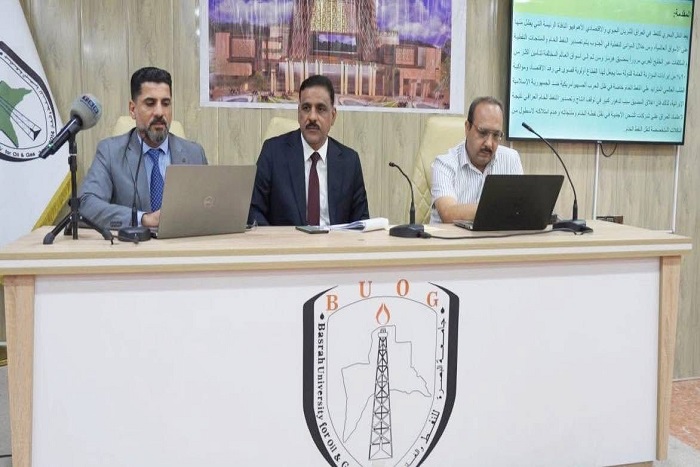
On Monday morning (April 20, 2026), the College of Industrial Management for Oil and Gas organized a scientific symposium titled: (Challenges and Prospects of Maritime Oil Transport in Iraq Amid Geopolitical Transformations). The symposium was presented by two distinguished guests: Dr. Najmuddin Abdullah Al-Hajjaj, Head of Department at the Iraqi Ports Company, and Dr. Hussein Haidar Al-Jazaeri, Chief Engineer at the Iraqi Oil Tankers Company. The symposium was moderated by Dr. Adnan Hadi Ja'az, Head of the Department of Oil and Gas Economics, under the supervision of the Dean of the College, Professor Dr. Sami Obaid Mohammed Al-Tamimi, and attended by department heads, esteemed faculty members, and college students.
The first research paper indicated that the Iraqi economy relies primarily on crude oil exports, which are transported through Iraq's oil and commercial ports via the Strait of Hormuz, with 90% of Iraq's oil exports passing through the strait. Any disruption in oil exports poses a direct threat to economic stability, as the strait is one of the world's most important maritime corridors, through which 20–50% of global oil trade passes, and it is the main outlet for Iraqi exports and imports via the Arabian Gulf. Therefore, studying the impact of the Strait of Hormuz on Iraqi oil exports and imports reveals that any closure leads to a significant decline in the volume of Iraq's exports, imports, and revenues, as occurred during recent geopolitical crises that caused a drop in production, negatively affecting the country's economic development.
The second research paper addressed the importance of maritime oil transport for Iraq, as it is the vital and economic corridor through which Iraq accesses global markets. Most of Iraq's crude oil, petroleum products, and condensates are exported through southern ports via the Arabian Gulf and the Strait of Hormuz. Consequently, closure of the strait—resulting from the Zionist-American war against the Islamic Republic—would cause major economic deterioration for Iraq due to foreign shipping companies' reluctance to enter the Arabian Gulf region to transport Iraqi oil, given the high war risks and insurance costs. Therefore, Iraq must possess a specialized national fleet for transporting its oil and reduce reliance on foreign companies, following the example of other Arab oil-producing countries. For instance, Saudi Arabia owns 81 tankers (45 for crude oil, 36 for petroleum and chemical products); Kuwait owns 33 tankers (15 for crude oil, 10 for petroleum products, 5 for gas, and 3 for fuel supply); Iran owns 64 crude oil tankers; Oman owns 50 tankers; the UAE owns 35 tankers; and Algeria owns 15 tankers. In contrast, Iraq owns only 6 small tankers with a total capacity not exceeding 750,000 barrels.
The symposium was enriched by interventions from the audience, notably from the Dean of the College of Industrial Management for Oil and Gas and the Director of the Oil Training Institute.


