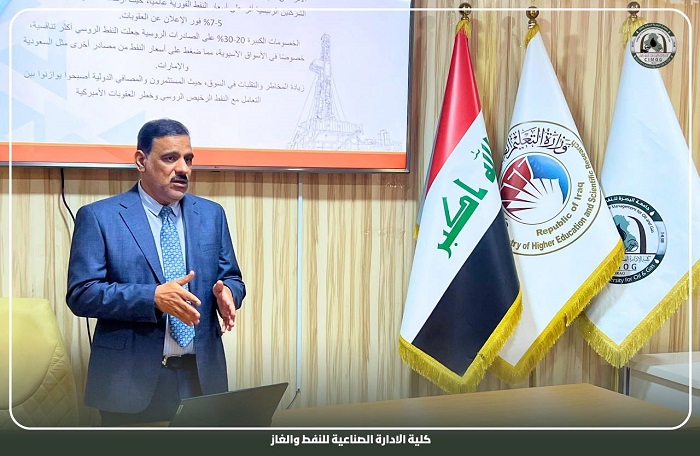
The College of Industrial Management for Oil and Gas / Department of "Oil and Gas Economics" organized a scientific workshop titled: (The International and Local Impact of US Sanctions on Russian Oil Companies) on the morning of Tuesday, November 4, 2025.
The workshop was presented by the Head of the Department of "Oil and Gas Economics," Dr. Adnan Hadi Jaaz. The highlights of the presentation included:
* The United States and Britain announced a new package of sanctions targeting the Russian economy, focusing this time on Russia's two energy giants and most important oil companies: Rosneft and Lukoil.
* Dr. Adnan Hadi began by reviewing the Russian economy, its key macroeconomic indicators such as GDP, the general budget, the source of foreign currency, the trade balance, and the contribution of oil and gas to each.
* He then reviewed the history of Western sanctions on Russia following the war with Ukraine, their impact on the Russian economy, and how the Russian economy managed to overcome them.
* The presentation covered the Russian oil and gas sector, including the volume of production, consumption, and export for each, and the role of the two companies in this sector.
* It highlighted the destinations of Russian oil, noting that Rosneft, the largest Russian oil company and the fifth-largest oil company globally, is a major exporter. Russia currently exports 4.8 million barrels per day (bpd), with 2.2 million bpd going to China and 1.7 million bpd to India, often at discounts reaching 30%. This indicates that China is the largest market for Russian oil, and the success of these measures is highly dependent on the reaction of China and India.
* Finally, Dr. Adnan discussed the global geopolitical situation, the true underlying reasons behind these sanctions, their expected impact on global energy markets and on the Western and Chinese economies, and the anticipated reaction from each. He concluded that these sanctions are merely one episode in the current international conflict that forms the basis of the coming world order.


